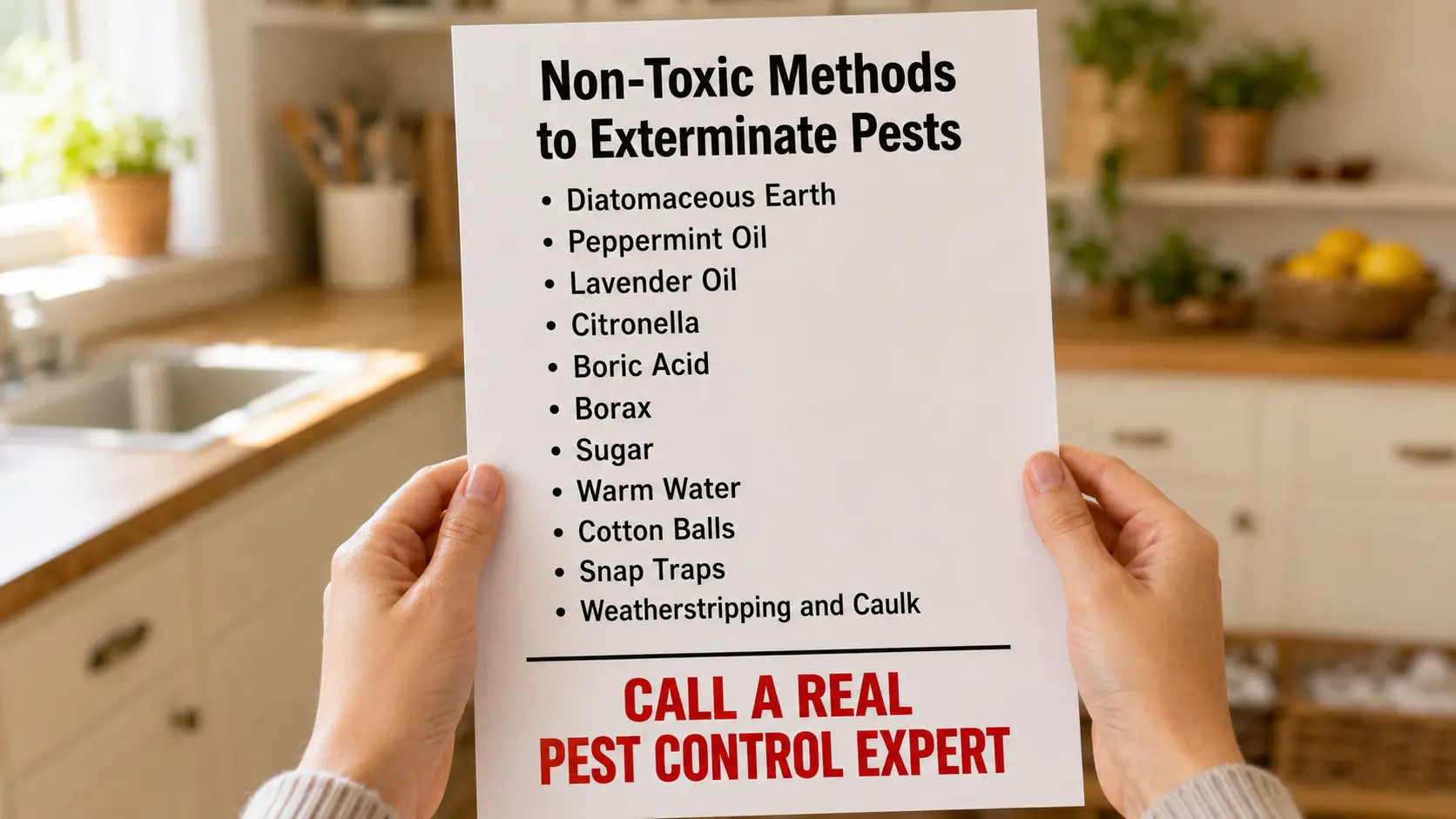
Effective Non-Toxic Methods for Eliminating Household Pests
Chemical pesticides work best but they come with health risks to children who crawl on the floor, cats, birds and fish, and the pungent odor that stays in the home for days. To steer clear of these issues, you have the option of organic or non-toxic pest control methods for getting rid of the pests living inside your home. Some of the treatments are not only non-toxic, but also more effective than chemical treatments in eliminating pests. This is because these methods use physical or mechanical treatments which makes it difficult for pests to develop resistance.
This guide is specifically for those homeowners who want to remove pests from their home staying completely away from harmful chemicals. We discuss what actually works and when a non-toxic treatment is enough and when you should acquire professional services.
Diatomaceous Earth
DE is a powdered form of the fossilized remains of microscopic aquatic organisms. At the microscopic level, the powder molecules have barbed edges that are fatal to insects with exoskeletons. When insects crawl through diatomaceous earth, these barbed molecules pierce through the insects’ outer layer, causing them to lose moisture and dehydrate. Since the method is purely physical and not chemical, pests cannot develop resistance to it over time.
DE is effective against a wide range of crawling insects that include ants, cockroaches, beetles, fleas, bed bugs and spiders. It can eliminate them within 4 hours to a few days after contact. It doesn’t work on flying insects like mosquitoes or flies. It works best when kept in a dry place and in Bryan and College Station, indoor application is far more reliable than outdoor use. Always buy food-grade DE, not pool-grade. Pool-grade DE is harmful to inhale.
Essential Oil Sprays
Essential oils work as pest repellents rather than killers. They disrupt the chemical signals that insects use to identify food sources. When they can’t locate the food, they are forced to move out in search of food. This is not a standalone solution for an infestation but is a highly effective preventive strategy for when pests are in the early stage of developing an infestation. Many essential oils are unpleasant to specific insects and will drive them away from the treated area. The key here is matching the oil to the pest.
| Oil | Best Against |
|---|---|
| Peppermint | Ants, spiders, mice |
| Lavender | Moths, fleas, flies |
| Citronella | Mosquitoes, flies |
| Eucalyptus | Flies, roaches, dust mites |
| Clove | Ants, roaches, flies |
| Cedarwood | Moths, ants, roaches |
Boric Acid and Borax Baits
Unlike contact killers that kill only the pests that touch them directly, boric acid wipes out entire colonies of pests. It is a naturally occurring mineral compound that foraging insects take back to their nest, thinking it’s food, where it spreads through the entire colony. This makes it one of the most effective non-toxic treatments for eliminating pests at the source rather than just killing the visible pests.
To prepare a DIY treatment for an ant infestation, take one cup of sugar, half a cup of warm water and one tablespoon of borax and mix them together. Soak cotton balls with the mixture or put it in bottle caps and place them along the ant trails. The foragers carry the mixture to their nest, spreading it like a disease to the entire ant colony. Remember not to use too much borax as it could kill the forager before it returns to its nest with the bait. A successful treatment will eliminate ant colonies in 3 to 7 days, and roaches in 2 weeks.
Heat Treatment
This is the best chemical-free solution for killing bed bugs and one of the most powerful non-toxic treatments available for any pest. Raising the temperature to above 113°F in any effective area for at least 90 minutes kills bed bugs at every life stage. There is no risk of chemical residue, waiting period to enter the treated area, or chances of pests developing a resistance against the treatment. No chemical treatment can penetrate every crack, seam or hidden space like this treatment.
Professional heat treatment is required if you want the entire home to be treated but you can use a DIY for individual items like clothes, bedding, stuffed animals or smaller fabric items. You can treat them by running a clothes dryer on high heat for at least 30 minutes.
Mechanical Traps
These traps are one of the oldest and most reliable pest control methods. The most important thing while setting up traps is the placement. An incorrect placement will do nothing, while a correct one will produce results within hours.
| Trap Type | Target Pest | Correct Placement |
|---|---|---|
| Snap traps | Mice & rats | Bait with peanut butter and place along the baseboards |
| UV light traps | Mosquitoes, gnats, fruit flies | Plug into outlet near the area with flying pests |
| Bed bug interceptors | Bed bugs | Under every bed and furniture leg |
| Sticky glue boards | Roaches, spiders, scorpions | Inside cabinet bases and along baseboards |
| Electric flea traps | Fleas | Plug in where your pet spends most time |
Physical Exclusion and Sealing
No method on this list is reliably more effective than simply not letting pests enter your home in the first place. Physical exclusion costs almost nothing compared to any kind of treatment and produces permanent results that no other treatment can match, whether it is chemical or non-chemical. In an area like Bryan and College Station, where pest pressure is a year-round thing, a well-sealed structure reduces the risk of indoor pest activity to a great level.
- Seal all gaps around pipes, conduit and wiring where they pass through a wall
- Install door sweeps on all exterior doors
- Seal windows and doors with weatherstripping. Check the fit annually
- Trim all tree branches away from your roof
- Caulk cracks around the foundation and around exterior electrical boxes
- Check and repair any damaged roof or fascia wood that invites wood-boring insects
Integrated Pest Management
The Environmental Protection Agency recommends IPM as the best pest control approach for residential properties. It is not a single treatment, it is a framework that uses multiple preventive approaches. IPM addresses root causes rather than symptoms is the reason it outperforms every other single treatment.
The four pillars of residential IPM
- Prevention
Fixing and removing everything that draws pests to your home
- Monitoring
Regularly inspecting your home for pest activity
- Mechanical & biological control
Applying non-toxic methods when pests are detected
- Targeted treatment only when necessary
Using the lowest-toxicity professional treatment when non-toxic methods are not enough
When Non-Toxic Methods are Not Enough
| Pest Situation | Non-Toxic Enough? |
|---|---|
| Minor ant trail in kitchen | Yes |
| Few roaches spotted | Yes |
| One or two rodents | Yes |
| Established ant colony inside walls | Partly |
| Roach infestation | Partly |
| Bed Bugs (light) | Partly |
| Bed Bugs (established) | No |
| Termites | No |
| Rodent infestation in the attic | No |
Conclusion
For most of the household pest problems, non-toxic pest control methods can deliver results as good as chemical treatments. The most important thing is using the right method for the right pest, applying it correctly and knowing when a situation has moved beyond a DIY approach.